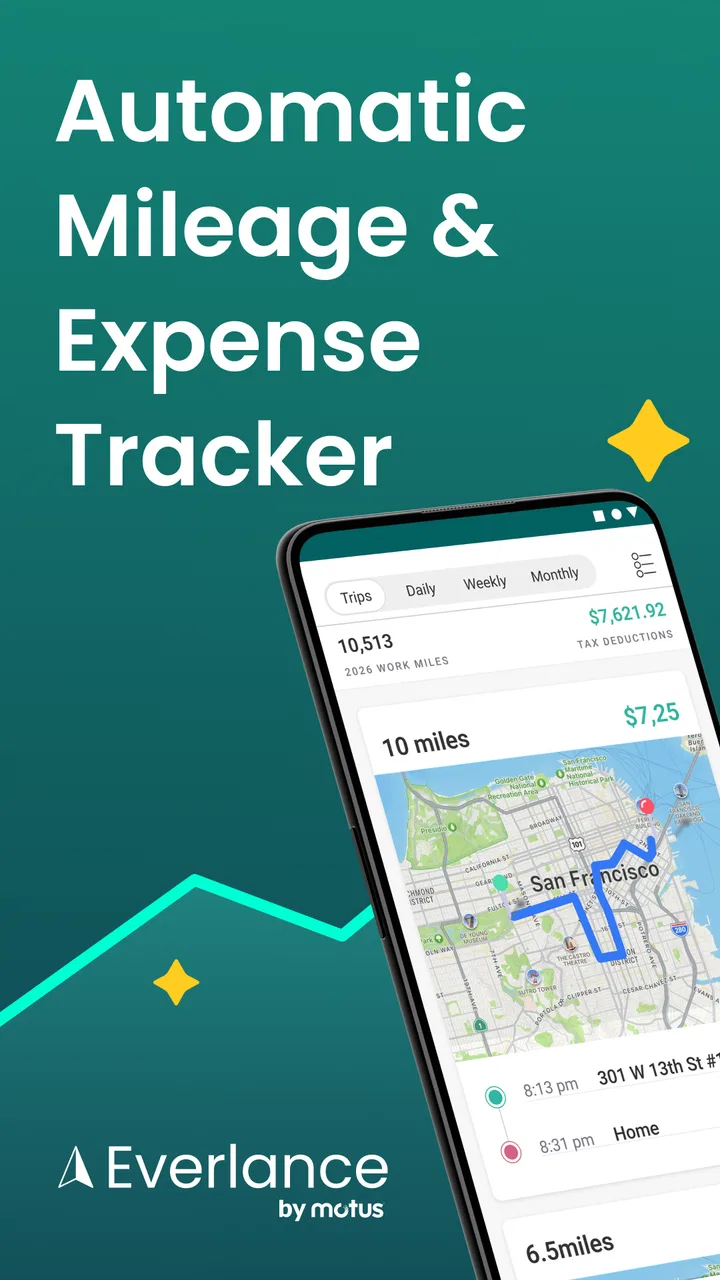
Everlance: Mileage Tracker
- 4.7
- Rating
- 1.00M
- Installs
- Free
- Price

 Analysis by App-foxy
Before I made a mileage tracker part of a work routine, I would decide what a useful record needs to contain: not just a route, but a clear reason for the trip and enough context to review it later. That distinction matters with mixed-use driving, where a business stop and a personal errand can happen on the same outing. Consistent review is what turns captured mileage into a record I can trust.
I found Everlance: Mileage Tracker most useful when I treated it as a work record rather than just a driving app. It belongs to the finance category, and its purpose is straightforward: help people keep track of business mileage and expenses without relying on memory at the end of a busy week. That sounds simple, but it addresses a very real problem. A forgotten trip or missing receipt can make tax preparation more stressful than it needs to be.
My overall impression is positive, especially for drivers who regularly use a personal vehicle for work. The app is free to install, has an Everyone age rating, and comes from Everlance Mileage Tracker. Its current release is version 5.1.1, and it can run on Android devices using Android 5.0 or later. Those details make it accessible to a wide range of users, including people who do not own a recent phone.
You May Also Like

 Blood Strike: 2.5 Anniversary
Blood Strike’s Loadouts Turn Every Drop Into a Tactical Gamble
A close look at Blood Strike’s custom loadouts: how fast access to signature weapons reshapes its battle royale rhythm, rewards preparation, and narrows the gap between fights.

 Pandora - Music & Podcasts
Pandora’s Music Is Easy to Start, but Harder to Recover
Pandora’s strength is its low-effort path from a seed to a station. Its weak spot is how much confidence it asks you to place in connection, setup, and quiet recovery.

 8 Ball Pool
 Is Built on Rivalries, Rematches, and Routine
A close look at the rivalries, rematches, shared routines, and unanswered safety questions that turn a quick pool match into a persistent mobile community.

 Samsung Music
’s Quiet Strength Is Playing What You Already Own
Its reach comes less from spectacle than from dependable access to a personal library. That simplicity is both the app’s strongest retention engine and its ceiling.

 AccuWeather: Weather Radar
AccuWeather Review: A Quick, Clear Forecast for Everyday Decisions
For everyday plans, the best forecast is the one you can understand quickly. AccuWeather makes rain timing, radar, and local conditions easy to act on, with a few trade-offs.

 Hill Climb Racing
Why Hill Climb Racing Still Turns Crashes Into One More Run
A tiny car, a bumpy hill and one more upgrade: Hill Climb Racing keeps resurfacing because its simple chaos makes every near-miss feel personal.
More From Our News Desk



How Everlance fits into everyday money tracking
The main appeal is continuity. Instead of trying to reconstruct a month of driving from a calendar, text messages, fuel stops, or vague recollections, I can use a dedicated place for mileage and work-related costs. That shift matters because mileage records are easiest to maintain while the information is still fresh.
A realistic example would be a self-employed cleaner who drives from home to several clients, buys supplies during the day, and occasionally makes a separate personal stop. With a conventional spreadsheet, every trip has to be remembered and entered manually. With a mileage tracker, the goal is to capture the driving as it happens, then sort out the business and personal portions before the records are needed.
I would not describe this as an accounting replacement. It is better understood as the collection layer that sits before accounting. It helps gather the raw details that can later support tax preparation, reimbursement requests, budgeting, or a conversation with an accountant. That distinction is important: the app can make records more organized, but it does not remove the need for sensible classification and review.
The product has been available since August 2, 2016, which gives it a longer history than many short-lived mileage tools. Its store presence shows a 4.7 average from around 33 thousand ratings, with roughly 10 thousand written reviews and more than a million installs. Those figures suggest that it has reached a substantial audience, although popularity should not be confused with a guarantee that its workflow will suit every driver.
What the free entry point really means
The app is listed as free, so I can begin without paying an upfront purchase price. That makes it easier to test the basic experience before deciding whether it deserves a permanent place in my work routine. For someone who only needs occasional mileage notes, free access may be enough to make the app worthwhile.
There are also in-app purchases, with individual items ranging from $6.99 to $239.99. I would therefore avoid assuming that every useful capability is included indefinitely at no cost. The sensible approach is to start with the free experience, identify the exact problem I need to solve, and only then consider a paid option. A large possible purchase range makes it especially important to read the current in-app descriptions carefully before confirming anything.
This is where the app’s value becomes personal. A driver who loses only a few trips each year may not recover enough benefit from a paid upgrade to justify it. Someone who drives for work several days a week may see much more value in reducing forgotten records and end-of-year reconstruction. The free starting point is a strength, but the paid value depends on usage rather than on the app’s name alone.
The workflow I would use
I would set up a simple routine instead of opening the app only when tax season arrives. At the beginning of a workday, I would make sure the phone is ready to record the relevant driving. After the day ends, I would review the trips while I still remember why each one happened. That second step is the part many people skip, and it is also where the records become useful.
For mixed-use driving, I would classify each trip immediately rather than waiting for a large batch. A trip to a client, a supply store, and a personal appointment may all happen within the same afternoon, but they should not be treated as one undifferentiated journey. Reviewing them separately reduces the chance that a personal drive gets counted as work mileage simply because it was near a business stop.
My most practical tip is to create a weekly checkpoint. I would compare the app’s records with my calendar and work messages, looking for obvious gaps or trips that need a clearer label. This is more reliable than trusting an automatic record blindly. Automation saves effort, but a quick human review protects the quality of the final record.
Another useful habit is to keep expenses connected to the reason for the trip. If I buy parking, supplies, or another work-related item, I would record it near the same time and add enough context to recognize it later. A bare amount may be difficult to interpret months afterward. The app is most valuable when it preserves meaning, not merely numbers.
Where the app delivers real value
The strongest benefit is reduced mental load. I do not have to remember every odometer detail or reconstruct a route from scattered evidence. That is particularly helpful for delivery workers, contractors, salespeople, home-service professionals, and anyone who visits multiple work locations in one day.
It can also make conversations with an accountant or employer more productive. Instead of handing over a pile of unorganized notes, I can work toward a clearer record of business travel and related spending. The app does not decide the correct tax treatment for me, but it can make the underlying information easier to inspect.
I also see value for people who are not self-employed. An employee who uses a personal car for reimbursable work travel may benefit from having a consistent record rather than submitting estimates. Whether that fits a particular employer’s process is another matter, so I would check the required format before relying on the app as the only record.
The app’s age rating of Everyone is reassuring for general accessibility, but it does not mean every financial decision becomes automatic or risk-free. I would still treat the records as financial documents: review them, keep supporting receipts where appropriate, and avoid assuming that an automatically captured journey is automatically deductible.
Tradeoffs that matter before committing
Automatic tracking is convenient, but convenience can bring friction. A mileage tool has to notice driving without turning every movement into a business trip. That means I would expect to spend time correcting classifications, especially when my personal and professional routes overlap. If I dislike reviewing records, the app may create a different kind of chore rather than eliminating work altogether.
Battery and privacy are also reasonable considerations for any app that deals with location-related driving records. I would check how the phone behaves during a normal workday and read the app’s current permission and privacy explanations before making it part of my routine. I would not promise that automatic tracking is invisible or effortless on every device, because phone settings and battery management vary widely.
The app is not the best match for somebody who wants a full bookkeeping system in one place. If my main needs are invoices, payroll, bank reconciliation, inventory, or detailed business reporting, I would choose dedicated accounting software and use a mileage tool only if it integrates cleanly with that workflow. Everlance can organize an important slice of financial information, but mileage is still only one slice.
There is also a cost tradeoff. Free access lowers the barrier to trying it, but the presence of paid items means I should not evaluate the product on the assumption that every advanced convenience is free forever. I would compare the actual purchase option shown in the app with the time I expect to save. For a high-mileage worker, that calculation may be favorable; for an occasional driver, manual notes may remain the cheaper choice.
Finally, automatic records still need judgment. A route can be captured correctly and classified incorrectly. A receipt can be entered with the wrong category. A trip can be missing because the phone was unavailable or the workflow was interrupted. The app reduces the amount of manual work, but it does not replace a weekly audit.
Who will get the most from it
I would recommend trying it first if I drove for several clients, made frequent deliveries, visited job sites, or used my own car for regular business travel. The more often I drive for work, the more expensive forgotten mileage becomes in time and potentially in missed reimbursement or deduction records. In those situations, a dedicated tracker is more practical than a notebook.
It is also a good candidate for someone who has repeatedly promised to “catch up later” and then faced a frustrating month-end or year-end reconstruction. The important change is behavioral: open the records regularly, classify them promptly, and treat the app as part of the workday rather than a rescue tool.
I would be more cautious for a person who drives for work only a handful of times, keeps an excellent paper log already, or strongly prefers not to use automatic location-based tools. In those cases, a simple spreadsheet or handwritten log may be easier to understand and control. The app’s free entry point makes testing inexpensive, but free does not automatically mean simpler.
People with older Android phones may appreciate that the minimum operating system is Android 5.0. Still, compatibility on paper is not the same as a smooth experience on every handset. I would test it during a normal week, including the places and driving patterns where I actually work, before depending on it for important records.
My decision after weighing the value
For me, the best reason to use Everlance is not the promise of effortless finances. It is the chance to build a more dependable mileage habit with less manual reconstruction. The free starting price makes that experiment reasonable, while the paid purchases mean I would make an upgrade decision only after understanding which extra value I am receiving.
I would choose it over a basic notes app when I had frequent work driving, mixed personal and business routes, and a genuine need to review mileage later. I would choose a spreadsheet or paper log when my trips were rare and predictable. I would choose broader accounting software when mileage was only a small part of a much larger bookkeeping problem.
The app is therefore not a universal answer, but it is a focused and credible tool for people whose work happens on the road. Its strong user reception, broad installation base, free entry point, and long availability make it worth testing. My final advice is to use the trial period to examine the complete routine: capture a normal workday, correct the classifications, record an expense, and perform a weekly review. The real value appears when the app turns scattered driving into records you can actually explain.
Making the records useful beyond the app
One detail I would plan before relying on any tracker is how I will preserve the information for the person who eventually needs it. An accountant may want a clear business purpose, while an employer may have a particular reimbursement process. I would use a consistent naming habit for recurring destinations or work types where the app allows it, then check that the resulting records are understandable without relying on my memory.
For a day with several short jobs, I would also compare the trip sequence against my calendar before the week closes. This is a practical way to spot a missed stop or a personal detour without trying to reconstruct the whole month later. The tracker can keep the driving organized, but I still need to supply the context that makes each entry defensible and useful.
What to expect as the product evolves
Version 5.1.1 is the current release I would assess when deciding whether to install it, while its availability since 2016 shows that the product has had time to develop. That history is encouraging, but it does not tell me what a future release will change. I would judge any later update by whether it improves the daily capture-and-review routine, keeps existing records easy to inspect, and makes costs clear before I commit to a purchase.
For an existing user, the practical question is less about chasing every new version and more about checking that the app still fits the way work travel is documented. If a routine is already reliable, I would preserve a separate record of important business details and review the app after changes, rather than assuming an update automatically improves every workflow. That cautious approach is especially sensible when mileage records matter for reimbursement or tax preparation.
My recommendation stays focused: this is worth trying when work driving is frequent enough that manual reconstruction is a recurring burden. It is less compelling when a simple log already works or when the real need is comprehensive bookkeeping. I would begin with one ordinary workweek, check the captured trips and expense notes, and decide from that experience whether the time saved justifies keeping it in my routine.
FAQs for Everlance: Mileage Tracker
01What is Everlance: Mileage Tracker used for?
Everlance: Mileage Tracker is designed to automatically track your mileage, helping freelancers and business professionals manage their driving expenses efficiently. It utilizes GPS technology to log trips accurately and provides detailed reports for tax deductions or reimbursements. Users can categorize trips as personal or business, ensuring seamless expense management.
02Is Everlance free to use, or does it have premium features?
Everlance offers a free version with basic mileage tracking features suited for personal use. However, for advanced features, such as automatic trip detection, unlimited tracking, and advanced reporting, users may opt for the premium subscription. This subscription includes additional functionalities tailored for business needs.
03How does Everlance ensure the accuracy of mileage tracking?
Everlance uses GPS technology to automatically record the start and end of your trips. It runs in the background to capture precise mileage data without manual input. The app also allows users to manually edit trip details if needed, ensuring that records are as accurate as possible for expense reporting.
04Can Everlance integrate with other financial tools?
Yes, Everlance integrates with various financial tools and platforms. It allows you to export your mileage and expense data in formats that are compatible with popular accounting software, such as QuickBooks and FreshBooks. This feature simplifies the process of managing finances and preparing for tax season.
05Will using Everlance drain my smartphone's battery?
Everlance is optimized to minimize battery consumption while providing accurate mileage tracking. The app uses advanced algorithms to efficiently manage GPS resources. However, like any GPS-based application, prolonged use may impact battery life, so users are encouraged to monitor their device's battery usage during extended trips.
Pros
- Easy-to-use interface for quick navigation.
- Automatic trip detection saves time.
- Accurate mileage tracking and reports.
- Seamless integration with other apps.
- Detailed expense management features.
Cons
- Premium features require a subscription.
- Initial setup can be time-consuming.
- Occasional GPS inaccuracies reported.
- Limited customization in free version.
- Some users experience sync delays.

Everlance: Mileage Tracker
Gallery